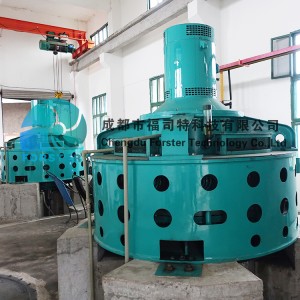
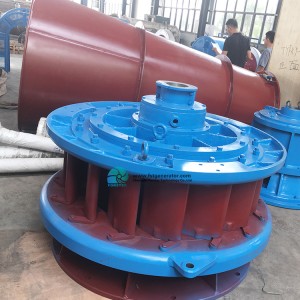
Eco-friendly Automatic Renewable Energy 200kW Propeller Water Turbine Generator


A propeller turbine is a type of axial-flow reaction turbine commonly used for low-head, high-flowrate hydroelectric power generation. As its name implies, its core component is a propeller-like runner, which features three to six fixed blades mounted on a central shaft. Water flows parallel to this shaft, passing through the stationary guide vanes that direct it onto the runner blades with minimal shock. The pressure of the water drops as it moves through the blades, transferring its energy and causing the runner to spin, which in turn rotates the generator to produce electricity.
These turbines are highly efficient within their specific design range but are best suited for sites with a relatively constant water flow, as their fixed blades cannot adjust to varying load conditions. A more advanced variant, the Kaplan turbine, addresses this limitation with adjustable blades. Due to their simple design and effectiveness in low-head applications, propeller turbines are a fundamental technology for harnessing clean, renewable energy from rivers and tidal basins worldwide. Their implementation provides a reliable and sustainable power source for many communities.
Technical Parameters of 200kW Propeller Turbine Generator
| Net Head | Hr | 3.4 | m |
| Design Flow Rate | Qr | 7.3 | m³/s |
| Power | P | 1×200 | kW |
| Turbine | Generator | ||
| Model | ZDK283-LMY-150 | Model | SF-W200-32/2150 |
| Unit Flow | 1.77m3/s | Rated Efficiency of Generator | 93% |
| Unit Rotating Speed | 152.5 | Frequency of the Generator | 50Hz |
| Max Hydraulic Thrust | 6t | Rated voltage of Generator | 380V |
| Rated Rotating Speed | 187.5rpm/min | Rated Current of the Generator | 379.85A |
| Model Efficiency of Turbine | 90% | Excitation | Brushless Excitation |
| Max Runway Speed | 368rpm/min | Connection Way | Direct Connect |
| Rated Output | 212kW | Max Runaway Speed | 375r/min |
| Rated Discharge | 7.3 | Rated Rotating Speed | 187.5r/min |
| Turbine Real Efficiency | 87% | Unit Support Form | Vertical |
Applications of a 200kW Propeller Turbine Generator
The 200kW unit is uniquely suited for a range of applications where a consistent, low-head water resource is available.
1. Rural and Off-Grid Electrification:
This is perhaps its most transformative application. Many remote villages, especially in developing nations, are located near rivers but lack connection to a central power grid. A single 200kW turbine can provide stable, 24/7 electricity for 50-200 households (depending on energy consumption standards), powering homes, schools, medical clinics, and small businesses. This fosters economic development, improves education and healthcare outcomes, and enhances overall quality of life.
2. Industrial Power for Small to Medium Enterprises (SMEs):
Many small industries, such as sawmills, textile mills, or food processing plants, were historically built near rivers for water access and mechanical power. A modern 200kW turbine generator allows these businesses to generate their own electricity, shielding them from grid price volatility and power outages. This “behind-the-meter” generation significantly reduces operational expenses and improves energy security.
3. Supplementing Existing Grid Power and Microgrids:
These turbines can be connected to the local grid to feed clean energy into the system. They are also ideal anchors for community microgrids, where they can serve as the baseload power source, complemented by more intermittent sources like solar PV and backed up by battery storage systems.
4. Eco-Tourism and Resort Power:
Luxury eco-lodges and remote resorts seeking to minimize their environmental impact and operational costs can use an on-site 200kW turbine. Providing clean, silent, and reliable power from a nearby river aligns perfectly with a sustainability brand identity and ensures energy independence.
Key Advantages and Benefits
High Efficiency: Propeller turbines are known for their high efficiency (often over 90%) at their designed operating point, making excellent use of the available hydraulic energy.
Simplicity and Reliability: With fewer moving parts than more complex turbines like Francis turbines, propeller turbines are robust, require less maintenance, and have a long operational lifespan.
Low Civil Works Cost: Suitable for low-head sites means they do not require the construction of enormous dams. Installation often involves a weir, small diversion canal, or utilizing an existing drop in a canal, keeping initial costs manageable.
Sustainable and Eco-Friendly: As a run-of-river technology, it typically doesn’t require a large reservoir, thereby minimizing flooding, ecological disruption, and methane emissions associated with decomposing vegetation in reservoirs.
Predictable Baseload Power: Unlike solar and wind, river flow (especially in regulated canals or consistent waterways) is highly predictable, providing reliable baseload power 24 hours a day.
Conclusion
The 200kW Propeller Water Turbine Generator is a testament to the idea that big impacts often come in appropriately sized packages. It is not a one-size-fits-all solution, but for the right site—a low-head, high-flow location—it represents one of the most cost-effective, reliable, and cleanest energy technologies available. By empowering communities, sustaining industries, and integrating seamlessly into agricultural and natural landscapes, this technology continues to be a vital tool in building a decentralized and sustainable energy future.