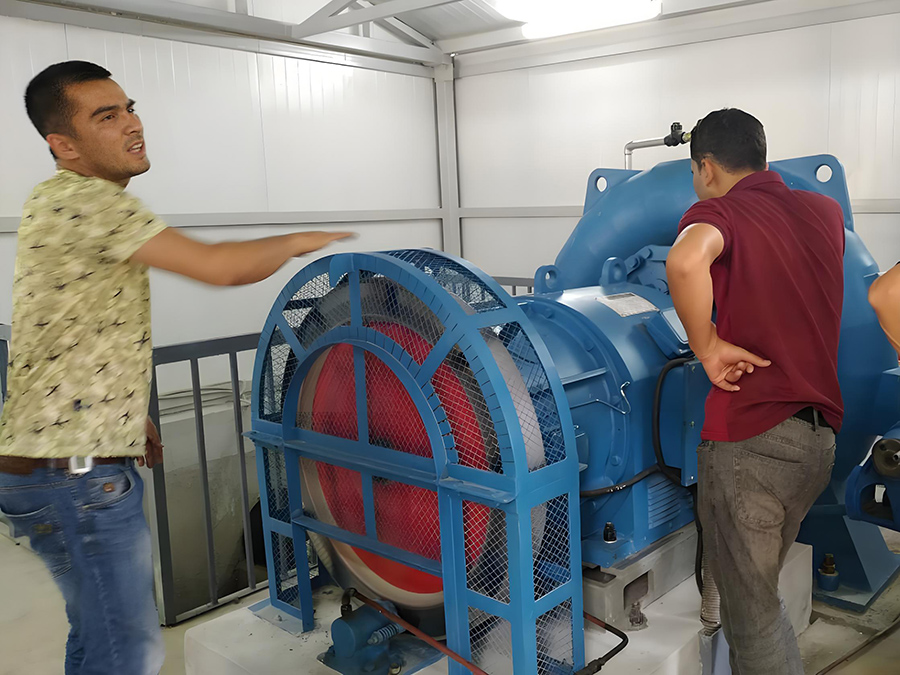
In the landscape of clean energy, hydropower stands as a vital pillar of energy transformation, thanks to its renewable nature, low cost, and strong peak load balancing capabilities. From the massive turbines of the Three Gorges Dam to the gentle flow of small hydropower plants in mountainous regions, the rotation of the turbine is always accompanied by the energy conversion from “water potential energy → mechanical energy → electrical energy.” The core appeal of hydropower lies in the exquisite adaptability of the hydropower turbine-generator unit under different water head and flow conditions. This dynamic demonstration model, through accurate replication of mainstream turbine types such as reaction turbines and impulse turbines, showcases the unique ingenuity of the interaction between the turbine and water flow. (1) Reaction Turbine Model: The “Embracing” Energy Exchange between Water Flow and Blades The Francis turbine model is the most widely used “all-rounder.” The model reproduces the core structure of a 700MW unit at the Three Gorges Power Station at a 1:25 scale. The runner has a diameter of 30cm and consists of 13 streamlined blades (15° inlet angle, 20° outlet angle) arranged radially; surrounding the runner are adjustable guide vanes (24 vanes, made of ABS plastic and metal frame composite), connected to a “governor ring,” which can adjust the guide vane opening (0-30°). The transparent casing is made of cast acrylic. Water (from a circulating water system driven by a micro pump) flows evenly into the casing from all sides, guided by the guide vanes, and impacts the runner blades at a simulated flow speed of 20m/s, driving the runner to rotate (150 rpm, corresponding to 125 rpm of the actual unit). The core of the dynamic demonstration lies in the energy conversion of “circumferential water intake”: When the guide vane opening is adjusted to 20°, the flow meter shows “simulated flow rate 5L/s”, the speed meter stabilizes at 150 rpm, and the generator model outputs 220V. When simulating “increased flow during flood season” (guide vane fully open), the turbine speed increases to 180 rpm, and the voltage rises to 240V. The screen simultaneously displays “Francis turbines are suitable for water heads of 50-700m and can achieve an efficiency of 95%”. This design makes the reaction principle of “pressure difference on both sides of the blades driving the turbine” intuitive, perfectly explaining why Francis turbines are the preferred choice for high water head and large flow rates. The axial flow turbine model showcases the advantages of “axial water intake” for low water heads, featuring both fixed and adjustable blade types. The adjustable blade model has a 40cm diameter rotor with 6 blades that rotate according to the water flow conditions (controlled by a micro servo motor), with a blade angle adjustment range of -10° to +15°. The guide vane and rotor are coaxially arranged, with water flowing axially into the rotor. The blades rotate under the combined effect of water thrust and their own rotation. The model’s “water head adjustment” interactive feature is unique: When the audience selects “low water head 3-5m” (e.g., a river in a plain), the blade angle is adjusted to +15° (increasing the water contact area), the guide vane opening is 30°, and the rotor speed is 60 rpm; switching to “medium water head 10-30m”, the blade angle is adjusted to 0°, the speed increases to 100 rpm, and the screen displays “Axial flow turbines can achieve an efficiency of 92% at high flow rates and low water heads”. The comparative demonstration of adjustable-pitch and fixed-pitch turbines has greater educational value: Under the same flow rate, the adjustable-pitch turbine, by adjusting the blade angle, achieves an efficiency 8-10% higher than the fixed-pitch turbine (the efficiency curve is displayed in real time on the screen), intuitively illustrating the technical advantage of “adjustable-pitch turbines being able to adapt to a wider range of flow rates.” This comparison is particularly important in teaching about small hydropower in irrigation areas, helping students understand “why axial-flow turbines are often used in rural small hydropower projects.” The inclined-flow turbine model is a “master of head adaptation,” with its runner blade axis at a 45° angle to the main shaft (between a mixed-flow and an axial-flow turbine). The model’s blades can be synchronously adjusted (from -5° to +25°), with the guide vanes and runner adjusting together. When the simulated head increases from 40m to 120m, the blade angle automatically adjusts from +25° to -5°, maintaining a stable runner speed of 120 rpm, demonstrating the characteristic of “high efficiency over a 3-fold head variation.” The transparent casing allows clear observation of the unique flow path, and the efficiency contour map on the screen helps viewers understand its “adaptability between mixed-flow and axial-flow turbines.”
(2) Impulse Turbine Model: “Collision-type” Energy Release of Water Flow and Blades
The Pelton turbine model is the “power champion” for high-head applications, replicating the classic design of the Leonhard power station in Switzerland. 12 cup-shaped buckets (each with a 50mL capacity, made of chrome-plated brass) are evenly distributed around the runner (25cm diameter); the “nozzle” (0.5cm diameter) rotates 360°. High-pressure water (provided by a plunger pump, simulating a head of 500-1000m) forms a high-speed jet (50m/s) that precisely impacts the “splitter” of the buckets, converting the kinetic energy of the water into the mechanical energy of the rotating runner. The highlight of the dynamic demonstration is the energy transfer through “jet impact”: When a single nozzle is activated, the water jet impacting the turbine wheel generates a noticeable “reaction force” (instantaneous acceleration of the rotor), reaching 300 rpm and a simulated generator output power of 500W. With two nozzles (symmetrically arranged), the speed increases to 580 rpm and the power to 980W. The screen displays that “the efficiency of this type of turbine can reach 90% under high water head, and the water does not enter the casing, making it suitable for water with high sediment content.” This design clearly illustrates the principle that “kinetic energy transfer does not depend on water pressure, but solely on the impact of high-speed water flow,” perfectly explaining why it is suitable for “mountainous hydropower plants with a head of over 100m.” The inclined-impact turbine model demonstrates the flexible adaptability of “oblique jet impact,” with the nozzle angled 22.5° to the turbine wheel plane, the water obliquely impacting the scoop-shaped blades (18 blades). The interactive feature allows viewers to adjust the nozzle angle, observing the change in rotor speed—a 10-15% decrease when the angle deviates from 22.5°, illustrating the impact of angle accuracy on efficiency. This type of model is often used to illustrate “small-scale hydropower in mountainous areas,” suitable for “distributed energy systems with a head of 20-300m and small flow rates.” The double-impact turbine model maximizes energy utilization by “water impacting the blades twice.” The turbine wheel has two layers of blades; after the first impact, the water flows through the wheel to impact the lower layer. The transparent wheel allows viewers to see the “double-impact” path. The screen displays that “while the efficiency of the double-impact design is slightly lower (75-85%), its simple structure and low cost make it suitable for rural micro-hydropower.” This design makes the “wisdom of energy utilization in simple designs” readily apparent. (3) Special Types of Hydro Turbine Models: Innovative Designs for Extreme Conditions
The bulb turbine model is a “flat-profile” solution for low-head hydropower plants. It features a “bulb-shaped” structure—the generator is housed within a bulb-shaped casing in the water flow path, and the turbine rotor is directly connected to the generator shaft (no spiral casing). Water flows axially through the unit. For simulated head heights of 2-8m (e.g., tidal power plants), the rotor (40cm diameter, 8 curved blades) rotates at 80 rpm. The screen displays “Bulb turbines can achieve efficiencies of up to 88%, suitable for riverbed power plants, with low civil engineering costs.” The transparent casing clearly shows the “straight-through water flow” characteristic, explaining its widespread use in low-head applications such as tidal and irrigation channels. The tidal turbine model demonstrates bidirectional power generation. Its rotor blades have a symmetrical “S-shape” design, allowing the rotor to rotate regardless of whether the water flows from left to right or right to left (60 rpm). The model is linked to a “tidal simulation tank,” which uses rising and falling water levels to create reciprocating flow, demonstrating the cycle of “power generation during high tide → power generation during low tide → shutdown during still tide.” The screen displays “Tidal turbines utilize lunar gravity, are renewable, and highly predictable.” This design makes the synergy between “clean energy and natural rhythms” visually evident.
Post time: Sep-10-2025
