Hydropower stands as one of humanity’s oldest and most reliable sources of renewable energy. At its core, it is a masterful application of fundamental physics, a continuous chain of energy transformations that harnesses the planet’s water cycle to generate electricity. This process, elegantly simple in principle yet complex in engineering, converts the innate energy of water in motion into the electrical power that fuels our modern world. The journey of this energy, from a distant raindrop to a glowing light bulb, is a captivating story of conversion through several distinct stages.
Stage 1: Potential Energy – The Primordial Reservoir
The entire process begins with solar energy. The sun heats the Earth’s surface, causing water from oceans, lakes, and rivers to evaporate. This water vapor condenses into clouds and eventually falls back to earth as precipitation—rain or snow. When this precipitation collects in a reservoir behind a dam or high in a mountain, it possesses a significant amount of gravitational potential energy. This energy is a function of two critical factors: the mass of the water and the height from which it can fall. The higher the dam and the greater the volume of the reservoir, the more potential energy is stored. This immense, dormant energy, symbolized by a tranquil lake, is the first and most crucial form of energy in the hydropower chain. It is the fuel, waiting to be released.
Stage 2: Kinetic Energy – The Unleashed Torrent
When the gates of the dam open or water is released from the intake, the stored potential energy is rapidly transformed. Guided by the immense pressure of the water column above, the water accelerates through a large pipe known as a penstock. As it flows downward, gravity acts upon it, and its potential energy is converted into kinetic energy—the energy of motion. The water’s velocity increases dramatically as it travels down the penstock. This conversion is direct and governed by the laws of conservation of energy; the loss in height (and thus potential energy) results in a proportional gain in speed and kinetic energy. By the time the water reaches the bottom of the penstock, it is a high-velocity jet, a powerful torrent focused entirely on the task of driving the turbine.
Stage 3: Mechanical Energy – The Spinning Heart
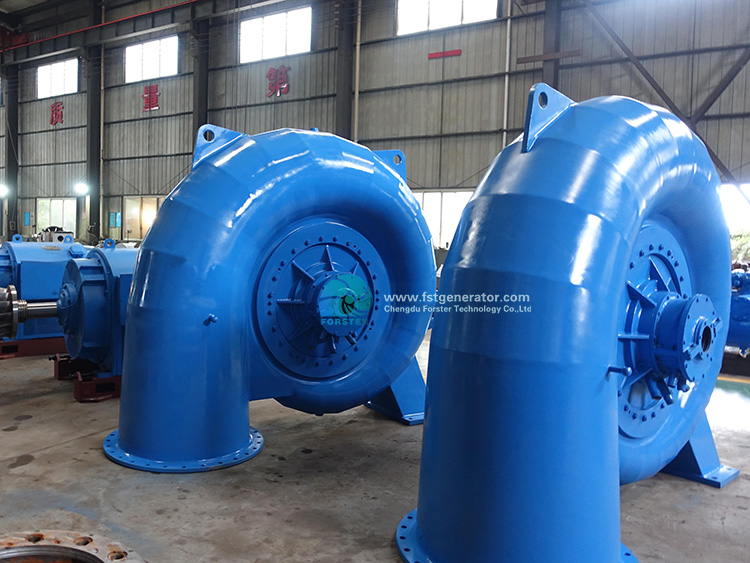
The high-velocity jet of water is now directed onto the blades of a turbine, which is the mechanical heart of the power plant. The turbine is a sophisticated rotor equipped with curved blades, designed to efficiently capture the water’s momentum. The impact of the water on the blades causes the turbine runner to spin rapidly. In this critical step, the kinetic energy of the moving water is transferred to the turbine and becomes rotational mechanical energy.
The design of the turbine is optimized for the specific site conditions. For high-head sites, Pelton wheels use cup-shaped buckets that the water jet strikes directly. For medium heads, Francis turbines, which react to water pressure and flow, are common. For low-head, high-flow situations, Kaplan turbines, which resemble a ship’s propeller, are often used. In each case, the turbine’s sole purpose is to maximize the extraction of energy from the water, converting its linear or pressure-driven force into a powerful, continuous rotation.
Stage 4: Electrical Energy – The Final Conversion
The spinning turbine is connected directly to a shaft, which in turn spins the rotor of an electrical generator located in the power house. Inside the generator, the rotor (a powerful electromagnet) is surrounded by the stator (a stationary set of copper windings). According to the principle of electromagnetic induction, discovered by Michael Faraday, when a magnetic field is rotated within a coil of wire, it induces an electric current to flow in the wire. Thus, the rotational mechanical energy of the turbine shaft is seamlessly converted into electrical energy within the generator.
This newly created electrical energy is in the form of alternating current (AC). Before it can be transmitted over long distances, its voltage is increased dramatically by transformers to reduce energy loss during transmission. From there, the electricity enters the power grid, a vast network of transmission lines that carries it to homes, businesses, and industries, where it is ultimately converted back into light, heat, and motion.
Efficiency and Losses
No energy conversion process is 100% efficient, and hydropower is no exception. Small losses occur at every stage due to friction (in the penstock and turbine bearings), turbulent flow, heat generation in the generator windings, and resistance in electrical wires. However, modern hydropower plants are remarkably efficient, often converting over 90% of the available potential energy in the water into electrical energy, a rate far superior to most other power generation methods.
In conclusion, the generation of hydropower is a elegant symphony of physics and engineering. It is a cascading transformation of energy—from the silent, stored potential high in the mountains, to the unleashed kinetic force of flowing water, to the spinning mechanical power of the turbine, and finally to the versatile electrical current that powers our civilization. It is a clean, renewable, and powerful testament to our ability to work in harmony with natural cycles.
Post time: Nov-28-2025
