The Turgo turbine is an impulse-type water turbine designed for medium-head applications, typically operating effectively with net heads between 15 and 300 meters. Invented and patented by Eric Crewdson in 1919, the Turgo was developed to fill a market need for a higher specific speed version of the Pelton turbine. Its design allows it to handle a greater flow rate than a Pelton wheel of the same diameter, leading to higher power output and often eliminating the need for costly speed-increasing transmissions by enabling direct connection to a generator.
Unlike the Pelton design, where water jets strike the buckets at the center and are deflected back, the Turgo’s jet is directed at an acute angle (typically 22.5°) to the runner’s plane. The water enters from one side of the runner and exits from the opposite, minimizing interference between the outflow and the incoming jet. This efficient flow path, combined with a runner that has a higher specific speed, makes the Turgo particularly well-suited for sites with large flow variations.
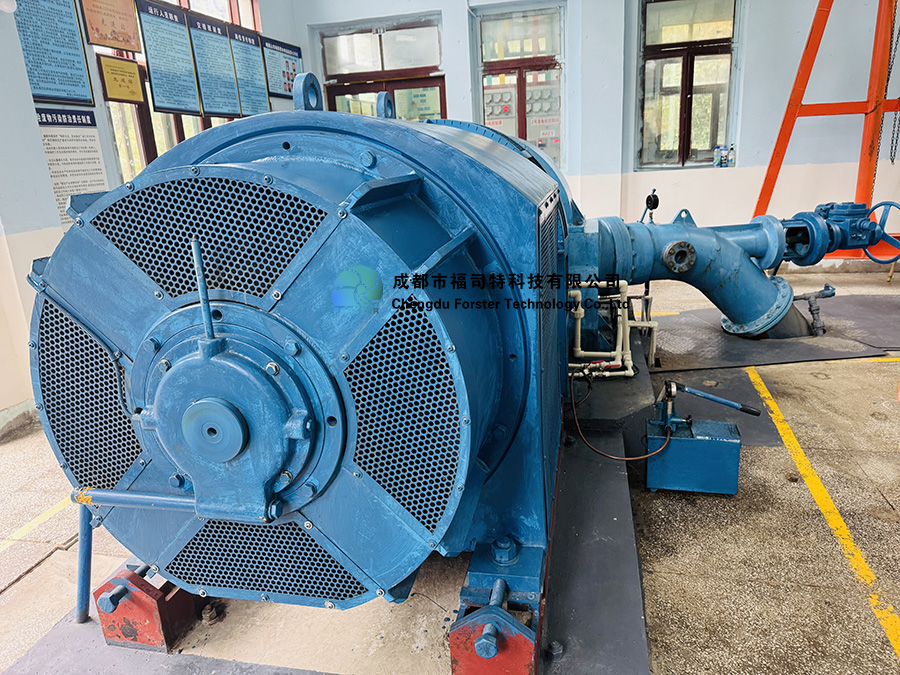
Key Components and Design
The manufacturing of a Turgo turbine requires a precise approach to its core components to ensure efficiency and durability.
The Runner
Function and Importance: The runner is the heart of the turbine, where the energy transfer from water to mechanical rotation occurs. Its design directly impacts the turbine’s efficiency.
Blade Design: Turgo runners feature blades with a complex 3D shape and a 勺状 (sháo zhuàng – scoop-like) form. The blade surface is designed to facilitate fast and complete water evacuation, minimizing the energy carried away by the outflow. For larger turbines, blades have an airfoil cross-section (like an airplane wing) for superior hydraulic performance, though this requires higher manufacturing precision. To reduce cost, smaller or micro-turbine blades are sometimes made in a hemispherical shape, which is simpler to produce with only a slight efficiency penalty.
Construction: The runner is typically assembled from multiple individual blades. A common construction method involves fabricating blades from 2mm thick steel sheet, often using a punch press, followed by trimming and finishing. These blades are then assembled and welded between an outer shroud (wài lún huán – outer wheel ring) and an inner hub (nèi lún gǔ – inner wheel hub). The outer shroud adds strength to the blades and helps reduce windage losses.
The Nozzle and Flow Control
Nozzle Function: The nozzle’s role is to accelerate the pressurized water from the penstock into a high-speed jet (shè liú -射流). It is a conical tube that gradually reduces in cross-sectional area, increasing the water’s velocity.
Flow Regulation: To control the turbine’s power output, the flow of water must be regulated. This is achieved either by a spear valve (or needle valve) located inside the nozzle, which moves forward and backward to change the jet diameter, or by a manual control valve on the penstock. Additionally, jet deflectors are used as a safety measure to quickly divert the jet away from the runner in case of a sudden load loss, protecting the turbine from overspeed and the penstock from surge pressures.
Bearings and Casing
Bearings: The bearing assembly must support the combined weight of the runner and generator rotor, withstand axial thrust, and handle radial forces during operation. A typical setup for a micro-hydro Turgo unit might include both a thrust roller bearing and a single-row radial ball bearing. These bearings are designed to be robust, capable of withstanding worst-case operating conditions, including temporary runaway speed.
Traditional Manufacturing and Fabrication
For steel runners, traditional metal casting and precision machining are common. The complex 3D shape of the blades often necessitates Computer Numerical Control (CNC) milling to achieve the required accuracy, especially for the more efficient airfoil profiles. As noted, for simpler micro-turbines, blades can be stamped or punched from sheet metal and then welded, which is a more cost-effective method.
The fabrication of the turbine’s structural components, like the casing, often involves welding of rolled steel plates. The nozzle and other flow control parts are typically machined from corrosion-resistant metals like bronze or stainless steel to withstand erosion.
Modern and Innovative Methods
Advanced Design Tools: Modern manufacturing heavily relies on Computational Fluid Dynamics (CFD) and other numerical design tools. These software packages allow engineers to simulate water flow through the runner, optimizing the blade geometry for maximum energy extraction and efficiency before any physical prototype is built.
Additive Manufacturing (3D Printing): 3D printing has emerged as a powerful tool for manufacturing, particularly for pico-scale Turgo turbines or for creating prototypes. Research has successfully produced complete Turgo turbine blades using 3D printers. The process involves:
Designing the blade in 3D modeling software (e.g., SolidWorks).
Exporting the design as an STL file.
Preparing the print with slicing software (e.g., Ultimaker Cura), where critical parameters like nozzle filament flow, infill density, support structures, and printing temperature must be carefully configured.
Executing the print on a calibrated 3D printer.
This method allows for the rapid and cost-effective production of complex parts, making it ideal for custom, small-scale applications.
Performance and Advantages
When manufactured correctly, Turgo turbines offer several compelling advantages:
Efficiency: A well-made Turgo turbine can achieve high efficiencies. Operational units typically reach about 87%, with some lab tests showing peaks of up to 90%. Pico-scale turbines can still achieve efficiencies over 80%.
Robustness and Low Maintenance: The Turgo turbine is known for its simple and robust construction, which translates to minimal maintenance requirements. Its design, particularly the angled jet path, results in less performance degradation from abrasive materials like sand or silt compared to other turbines, as wear is more evenly distributed across the blade surfaces.
Operational Flexibility: A key strength of the Turgo is its ability to maintain high efficiency over a wide range of flow rates. This makes it exceptionally suitable for run-of-river hydro schemes where water flow can vary significantly. Unlike Francis turbines, whose performance can drop sharply at lower flows, the Turgo continues to generate power effectively.
Future trends in Turgo turbine manufacturing point toward continued design optimization through advanced modeling and a broader adoption of additive manufacturing for both prototyping and final part production. As research and development efforts continue, as highlighted by various publications and academic works, we can expect further improvements in the performance and cost-effectiveness of these versatile hydropower machines.
Post time: Nov-17-2025
