The heart of any hydro turbine is its runner. This is the component that converts the energy of flowing water into rotational mechanical energy, which in turn drives the generator to produce electricity. Among all turbine types, the Francis runner, with its complex, twisted blades, represents one of the most challenging and precise components to manufacture. The process is a remarkable blend of traditional craftsmanship and cutting-edge digital engineering.
The Critical Role of the Runner
A runner’s performance directly dictates the efficiency, power output, and stability of the entire turbine unit. Imperfections in its geometry can lead to cavitation (the formation of damaging vapor bubbles), vibration, and significant energy losses. Therefore, manufacturing a runner is not just about building a metal part; it’s about sculpting a highly efficient energy conversion device.
Key Stages in Runner Manufacturing
1. Design and Engineering
The process begins with sophisticated Computational Fluid Dynamics (CFD) and Finite Element Analysis (FEA) simulations. Engineers optimize the blade profile, number of blades, and inlet/outlet angles to achieve maximum hydraulic efficiency and structural integrity for the specific project’s head and flow conditions.
2. Casting or Forging
Casting: For most large Francis runners, individual blades are precision-cast, typically from high-grade stainless steel (e.g., CA6NM or 13/4/5 Cr-Ni steel) to resist corrosion and cavitation erosion. The crown and band are also cast or forged separately.
Forging: For some high-stress applications, critical components may be forged to achieve superior mechanical properties and a more uniform grain structure.
3. Machining: Where Precision Takes Shape
This is the most critical phase, transforming rough castings into a high-precision assembly. Key machining operations include:
Rough Machining: Removing excess material from the cast blades, crown, and band to get close to the final shape.
CNC Milling: The core of the process. Using multi-axis Computer Numerical Control (CNC) milling machines, the complex, three-dimensional surfaces of the blades are meticulously carved. 5-axis CNC machines are essential to reach the deeply curved surfaces and undercuts without the need for multiple re-fixturing.
Fit-Up and Welding Preparation: The machined blades are carefully positioned and tack-welded between the crown and band. This requires extreme precision to ensure the final assembly aligns perfectly with the digital design model.
Welding: Highly skilled welders perform the final welding, joining the blades to the crown and band. This is often done using automated or robotic Submerged Arc Welding (SAW) or Gas Tungsten Arc Welding (GTAW/TIG) to ensure deep, consistent, and defect-free welds. Strict pre-heating and post-weld heat treatment (PWHT) procedures are followed to relieve stresses and prevent cracking.
4. Finishing and Quality Control
Dimensional Inspection: The entire welded runner is scanned using a portable Coordinate Measuring Machine (CMM) or laser scanners to verify that every contour matches the 3D CAD model within tight tolerances (often within fractions of a millimeter).
Surface Finishing: The blades are polished to a smooth finish. A hydraulically smooth surface reduces friction losses and minimizes the risk of cavitation inception.
Non-Destructive Testing (NDT): All welds are rigorously inspected using methods like Ultrasonic Testing (UT), Dye Penetrant Testing (PT), or Magnetic Particle Testing (MT) to detect any internal or surface defects.
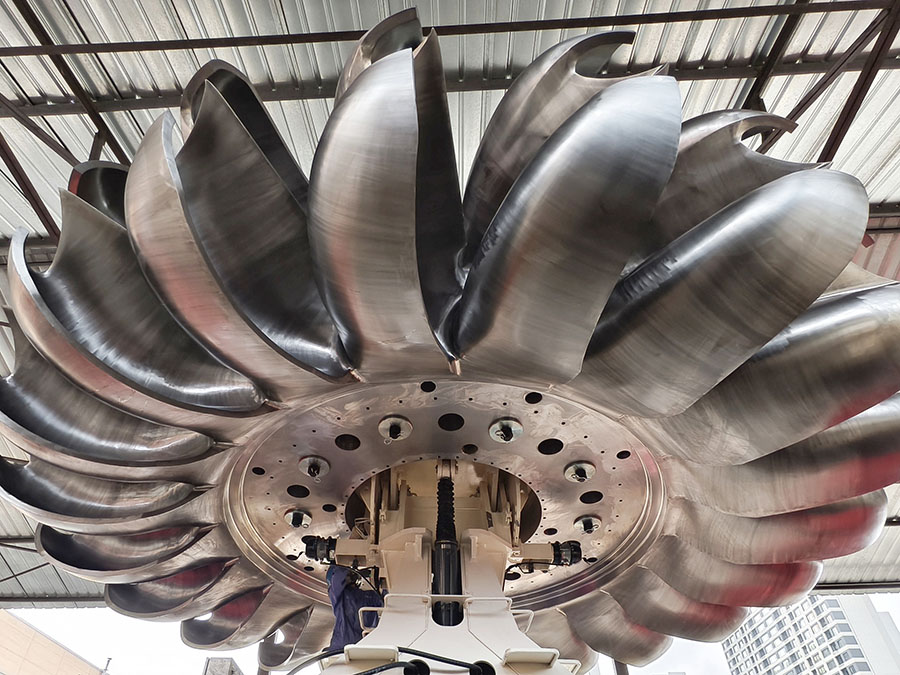
Balancing: The completed runner is dynamically balanced on a special balancing machine. Any heavy spots are identified and corrected by adding or removing small amounts of material to ensure smooth, vibration-free operation at high rotational speeds.
The Role of Advanced Technology
Modern runner manufacturing is impossible without advanced technology. Digital Twins—a virtual replica of the physical runner—allow engineers to simulate the machining and welding process, predicting and mitigating distortions before they happen. 5-Axis CNC Machining provides the flexibility and accuracy needed for the complex geometries. Robotic Welding and Automated NDT ensure consistent, high-quality results.
Conclusion
Manufacturing a hydro turbine runner is a capital- and skill-intensive process. It is a testament to human ingenuity, where advanced software, powerful machinery, and expert craftsmanship converge to create a component that will reliably harness the power of nature for decades. The quality of this single component is, quite literally, the driving force behind the world’s most reliable renewable energy source.
Post time: Nov-10-2025
