The construction of a dam for a hydropower station is one of humanity’s most monumental undertakings, a complex interplay of geology, engineering, and environmental science. It is the process of taming a river to harness its power, transforming the kinetic energy of flowing water into electricity. The process is multi-staged and can take years, or even a decade, to complete.
Phase 1: The Foundation – Investigation and Diversion
Before a single tonne of concrete is poured, extensive work is done behind the scenes.
Site Selection and Feasibility Studies: Engineers and geologists identify a suitable location, typically a narrow valley with a stable rock foundation. They conduct rigorous studies on hydrology, seismic activity, and environmental impact.
River Diversion: A river cannot be built through. The first major physical task is to divert the river’s flow away from the main construction site. This is often achieved by constructing tunnels or channels around the future dam site. Temporary cofferdams (earth or rock-filled enclosures) are built to create a dry work area.
Phase 2: The Core – Building the Structure
With the foundation exposed and dry, the main construction begins. The method depends on the dam type.
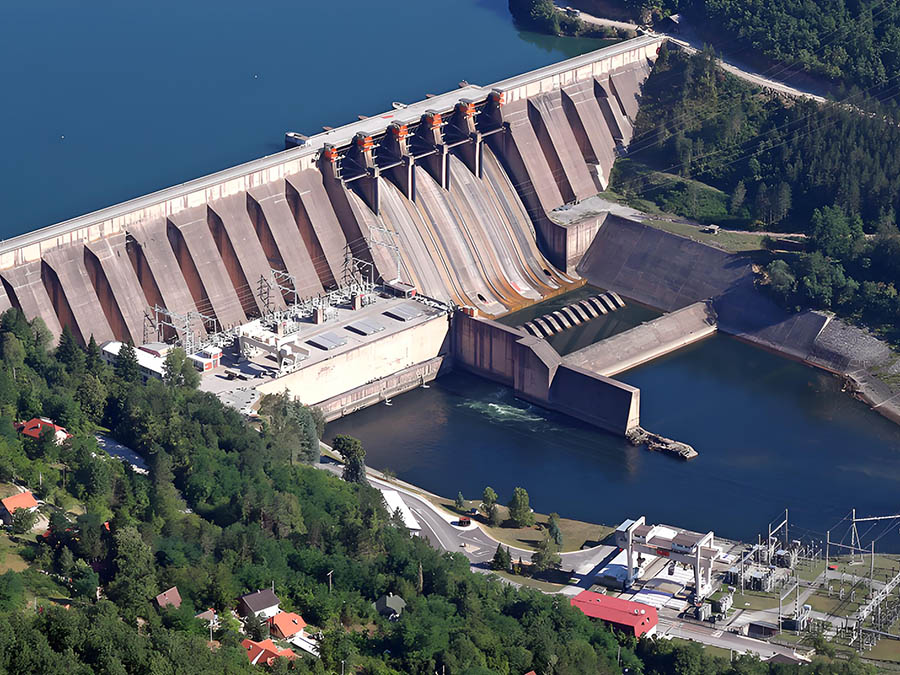
Concrete Gravity Dams: These massive structures (like the famous Hoover Dam) rely on their immense weight to hold back the water. They are built using a method called “compartmentalizing,” where the dam is poured in individual, interlocking blocks. This allows the heat from the curing concrete to dissipate, preventing cracks.
Embankment Dams (Rock-fill or Earth-fill): These are the most common type of large dams. They are not solid but consist of an impermeable clay core surrounded by zones of compacted earth and rock. The core prevents seepage, while the robust outer shells provide stability. Construction involves the systematic layering and compaction of these materials with heavy machinery.
Concrete Arch Dams: In narrow, rocky gorges, an arch dam is an elegant and efficient solution. It is curved upstream, using its shape to transfer the water’s force to the canyon walls, requiring less material than a gravity dam.
Phase 3: Integration and Impoundment
Installing Hydromechanical Equipment: As the dam rises, penstocks (large pipes) are embedded to carry water from the reservoir to the turbines in the powerhouse. The spillway, a crucial safety structure designed to release excess water, is also constructed.
The Powerhouse: This structure, located at the foot of the dam, is built to house the turbines and generators.
Impoundment: Once the dam is structurally complete and the turbines are installed, the diversion tunnels are closed. The river is allowed to flow back against the dam, and the reservoir begins to slowly fill behind it—a process that can take several months.
Engineering and Environmental Challenges
Dam construction is fraught with challenges. Engineers must account for immense hydraulic pressure, seismic forces, and long-term sedimentation. The project has significant environmental and social impacts, including the alteration of ecosystems and the displacement of communities, which require careful management, mitigation, and planning.
Conclusion: A Monumental Achievement
The construction of a hydropower dam is a testament to human ingenuity. It is a complex, large-scale project that creates a long-term source of renewable, low-carbon energy. While not without its impacts, a successfully built dam provides flood control, water storage, and clean electricity, powering communities and driving economic development for generations.
Post time: Nov-03-2025
