Nestled in the heart of a hydroelectric power plant, between the immense kinetic energy of the turbines and the vast expanse of the transmission grid, operates a critical piece of technology: the power transformer. Often overlooked, this silent sentinel is the crucial link that makes the long-distance delivery of renewable hydropower possible.
From Water to Wire: The Need for Transformation
The fundamental process of hydropower is elegant in its simplicity. Potential energy from stored water is converted into mechanical energy by a turbine, which then spins a generator to produce electricity. However, the alternating current (AC) electricity generated by these machines typically emerges at a medium voltage level, such as 11 kV, 13.8 kV, or 24 kV. While suitable for short distances, transmitting large amounts of power at this voltage is highly inefficient over long spans.
This is where the transformer performs its essential role. It is a static electrical device that uses the principle of electromagnetic induction to increase, or “step up,” the voltage for transmission. By boosting the voltage to extremely high levels—commonly 138 kV, 230 kV, 500 kV, or even higher—the transformer dramatically reduces the electrical current for a given amount of power.
This high-voltage, low-current combination is the key to efficient power transmission. According to Joule’s law, power losses in a conductor are proportional to the square of the current (P_loss = I²R). Therefore, by reducing the current, the transformer minimizes resistive losses in the transmission lines, ensuring that the clean energy generated by the waterfall travels hundreds of kilometers with maximum efficiency.
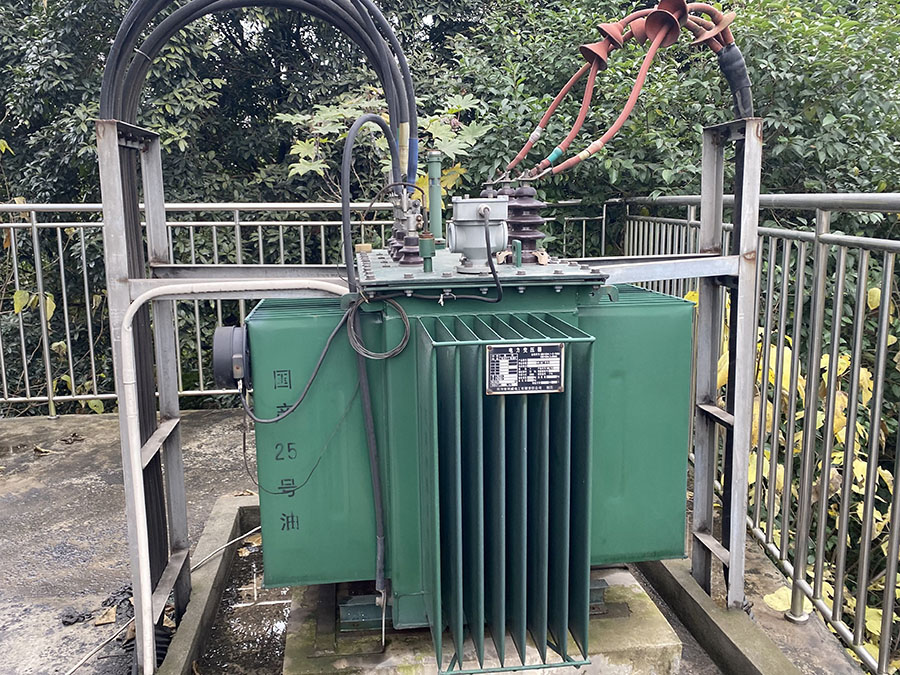
Anatomy of a Hydroelectric Plant Transformer
Transformers in hydroelectric plants are not ordinary units; they are robust, high-power machines designed for reliability.
Core and Windings: At its core (literally), it consists of a laminated steel core and two sets of copper or aluminum windings: the primary (low-voltage side connected to the generator) and the secondary (high-voltage side connected to the grid).
Cooling System: Handling massive amounts of power generates significant heat. Hydroelectric plant transformers employ sophisticated cooling systems, often using oil not just for insulation but also for heat dissipation. Common systems include:
ONAN (Oil Natural Air Natural): Relies on natural convection of oil and air.
ONAF (Oil Natural Air Forced): Uses fans to force air over the cooling radiators.
OFAF (Oil Forced Air Forced): Uses pumps to circulate oil and fans to cool it, used for the highest power ratings.
Conservator Tank: A key component is the conservator tank, which allows for the expansion and contraction of the insulating oil as the transformer heats up and cools down during operation.
Protection Systems: These transformers are equipped with a suite of protective devices, including Buchholz relays that detect internal faults, pressure relief devices, and sophisticated monitoring systems for temperature, gas analysis, and partial discharge.
Unique Challenges and Design Considerations
The environment of a hydroelectric plant presents specific challenges for transformer design and placement.
Location: They can be located indoors, outdoors, or even in underground caverns. Outdoor units must be built to withstand harsh weather conditions, while indoor units require advanced fire suppression and ventilation systems.
Transportation: Given their enormous size and weight, transporting these transformers to often remote, mountainous dam sites is a monumental logistical feat.
Redundancy and Reliability: As a single point of failure, the generator step-up (GSU) transformer’s reliability is paramount. Many plants have elaborate bypass systems or even a spare transformer on-site to minimize downtime during maintenance or failure.
Beyond the Generator: Other Transformers in the Plant
While the main step-up transformer is the star of the show, the power plant relies on an entire family of transformers:
Station Service Transformers: These “auxiliary transformers” step down the high voltage to lower levels (e.g., 480V) to power the plant’s own critical systems—lighting, control systems, cooling pumps, and gate motors.
Unit Auxiliary Transformers: These are directly connected to the generator’s output and provide power specifically for the auxiliary systems of that generating unit.
Conclusion
The hydroelectric transformer is a masterpiece of electrical engineering, a vital and robust component that acts as the gateway between generation and consumption. Without its ability to efficiently step up voltage, the clean, renewable power harnessed from rivers and dams would never reach the cities and industries that depend on it. It stands as a silent, powerful testament to the ingenuity required to power our modern world sustainably.
Post time: Oct-17-2025
