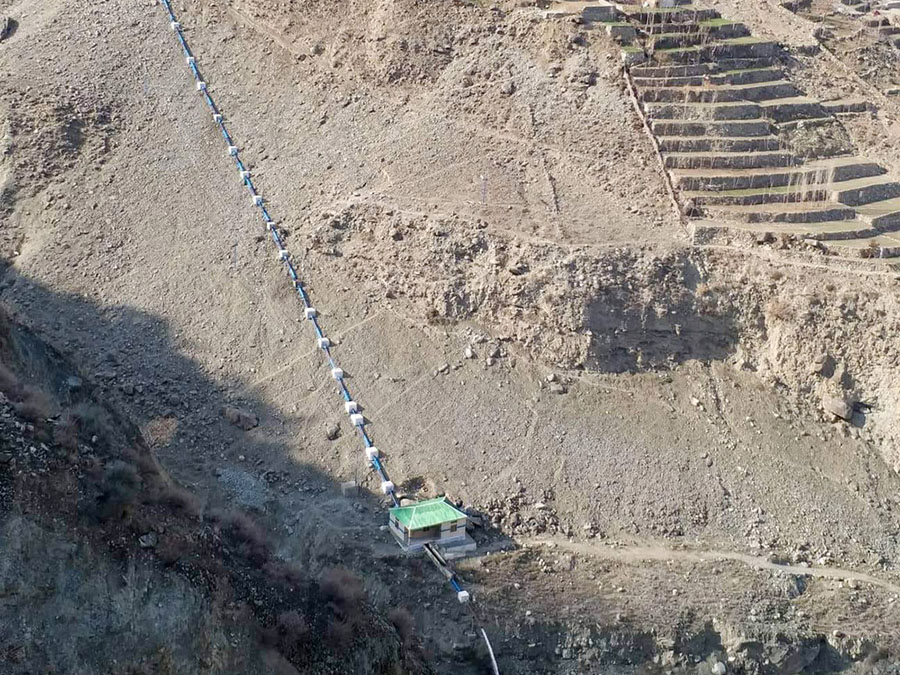
Nestled in the world’s mountainous regions, where water cascades down steep slopes with tremendous force, lies a masterpiece of renewable energy engineering: the high-head Pelton Turbine power station. Unlike conventional dams that rely on massive volumes of water, these plants are specialists, designed to convert the raw, kinetic energy of high-velocity water jets into clean, reliable electricity.
The Principle: Power from Pressure and Velocity
The core principle behind a high-head hydroelectric plant is the conversion of potential energy. Water is collected from a stream or reservoir at a high elevation. It then travels down a long, large-diameter pipe known as a penstock. As the water descends, its gravitational potential energy is transformed into high pressure and, crucially, high velocity.
This is where the Pelton turbine shines. It is the undisputed champion of high-head, low-flow conditions, typically operating effectively with heads from 150 meters to over 2,000 meters.
The Heart of the System: The Pelton Turbine Generator
The turbine itself is a study in elegant efficiency. Its key components include:
The Runner: The central rotating unit, equipped with multiple double-cupped buckets, often shaped like half-shells. These are meticulously designed to split the water jet and reverse its flow direction, extracting the maximum possible energy.
The Nozzle: Positioned precisely, the nozzle focuses the high-pressure water from the penstock into a coherent, high-speed jet. A spear valve inside the nozzle controls the flow, acting like a throttle for the entire system.
The Casing: The outer shell that contains the turbine and directs the now-de-energized water to the tailrace (outflow channel).
The Generator: Connected directly to the turbine shaft, the generator converts the rotational mechanical energy into electrical energy.
How It Works in Action:
The high-velocity jet of water strikes the Pelton wheel’s buckets at atmospheric pressure. The unique shape of the buckets captures the jet’s momentum, forcing the runner to spin. After imparting its energy, the water falls away with minimal residual velocity, demonstrating the turbine’s exceptional efficiency, which can exceed 90%.
Key Advantages of Pelton Turbine Power Stations
Exceptional for High Heads: Its design is uniquely suited to exploit the immense pressure built up in steep terrains.
High Efficiency: The near-complete energy transfer from the water jet to the runner makes it one of the most efficient turbine types available.
Robust and Reliable: The mechanical simplicity of the design leads to a long operational life with minimal maintenance, a critical factor for remote locations.
Excellent Part-Load Operation: Pelton turbines can maintain high efficiency even when the water flow is reduced by adjusting the spear valve, making them adaptable to seasonal water variations.
Real-World Applications
High-head Pelton turbine stations are vital for power generation in alpine countries and rugged landscapes. They are the technology of choice for:
Mountainous Communities: Providing stable power to towns and villages in the Alps, Himalayas, and Andes.
Industrial Operations: Powering remote mines or manufacturing plants.
Island Grids: In volcanic islands with steep terrain, they provide a key source of renewable energy.
A Pillar of Sustainable Energy
In the global pursuit of a sustainable energy future, high-head Pelton turbine power stations represent a mature, highly effective, and clean technology. They exemplify how human ingenuity can work in harmony with nature’s geography, turning the relentless force of falling water into a powerful catalyst for development, all without producing greenhouse gas emissions.
By harnessing the power of elevation, these facilities continue to be an indispensable part of the world’s renewable energy portfolio, proving that sometimes, the most powerful solutions come from the highest places.
Post time: Oct-13-2025
