The selection of an appropriate turbine is a critical determinant of the efficiency, economic viability, and long-term operational success of a hydropower project. For low-head sites, typically defined as those with a hydraulic head of less than 20 meters (65 feet), this decision becomes particularly complex due to the high volumetric flow requirements and the physical constraints of the machinery. This article explores the key turbine technologies suitable for low-head applications, the primary selection criteria, and the overarching considerations that guide engineers toward an optimal choice.
1. Introduction
Low-head hydropower represents a significant and often untapped potential for renewable energy generation, especially in riverine environments and irrigation canals. Unlike high-head projects where the powerful jet of water drives turbines, low-head installations rely on moving large volumes of water through a minimal height difference. This fundamental characteristic dictates the use of reaction turbines, which operate fully submerged and exploit both the pressure and velocity energy of the water.
2. Key Selection Criteria
The choice of turbine is not made in isolation but is the result of a careful analysis of site-specific parameters:
Head (H): The vertical distance between the upstream water level and the tailwater level. This is the primary driver for turbine type selection.
Flow Rate (Q): The volume of water available per second (m³/s or cfs). Head and flow together determine the potential power (P = η * ρ * g * H * Q, where η is efficiency).
Site Geology & Topography: Determines the civil works required for the powerhouse and water passages.
Operational Requirements: Whether the plant will operate at a near-constant flow (baseload) or must accommodate significant variations in flow (peaking power).
Grid Requirements: The need for speed regulation and synchronization with the electrical grid.
Environmental Considerations: Fish friendliness and minimizing ecological disruption are increasingly important.
Economic Factors: Capital cost, maintenance complexity, and overall lifecycle cost.
3. Primary Turbine Types for Low-Head Applications
3.1. Kaplan Turbine
A Kaplan turbine is a propeller-type turbine with adjustable blades and adjustable wicket gates (double-regulated), making it exceptionally versatile.
Operating Range: Ideal for heads from 5 to 70 meters, but most efficient in the low-head range (10 – 30m).
Flow: Best for medium to high flow rates.
Key Advantage: Its double regulation allows it to maintain high efficiency (over 90%) over a wide range of operating conditions (head and flow). This makes it perfect for sites with seasonal variations in water flow or head.
Application: The go-to solution for large-scale, low-head run-of-river projects.
3.2. Bulb Turbine
A Bulb turbine is essentially a Kaplan turbine where the generator is sealed in a watertight “bulb” nacelle located directly in the water flow. The turbine itself is a fixed-propeller or Kaplan type.
Operating Range: Extremely low heads, typically from 2 to 25 meters.
Flow: Designed for very high flow rates.
Key Advantage: The compact, straight-line flow path minimizes hydraulic losses and civil construction costs, as it requires a much smaller powerhouse. It is highly efficient for its specific design point.
Application: The standard for tidal power plants and very low-head river barrage schemes (e.g., the Rance Tidal Power Station in France).
3.3. Straflo Turbine
Similar to the Bulb turbine, a Straflo (Straight Flow) turbine integrates the generator rotor on the periphery of the turbine runner, contained within the discharge ring. The generator stator is housed in the surrounding structure.
Operating Range: Very low heads, similar to Bulb turbines.
Key Advantage: Offers even more compactness than a Bulb turbine, simplifying maintenance access to the generator.
Application: A niche but effective design for specific ultra-low-head applications.
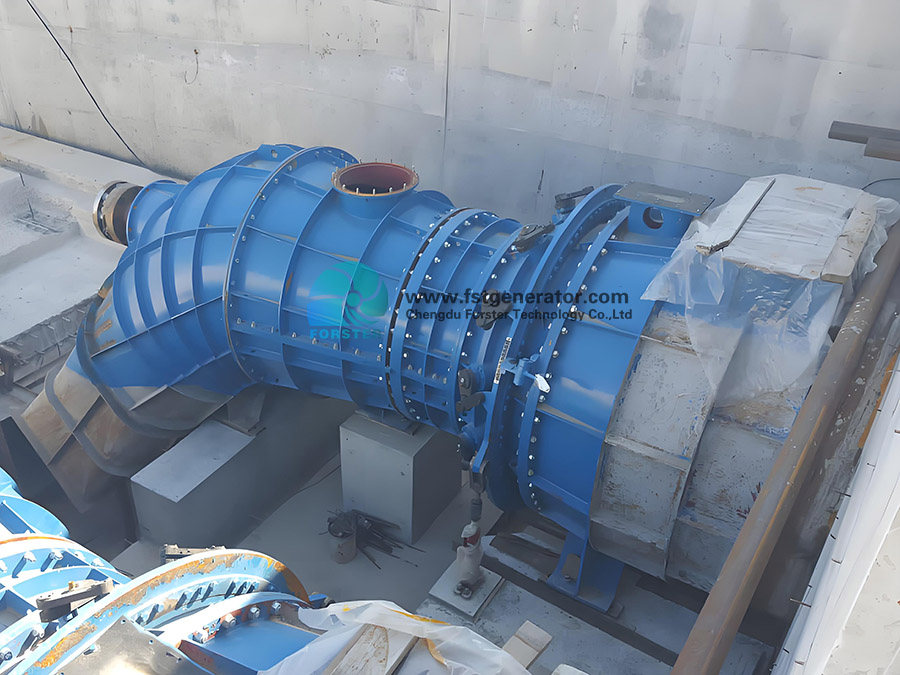
3.4. Tube Turbine
This is a broader category that includes any turbine with an S-shaped water passage where the inlet and outlet are aligned for a straight-through flow. Both Bulb and Straflo turbines are types of tube turbines. The S-shape allows the generator to be placed outside the water passage for easier maintenance.
Operating Range: Low heads, typically below 15 meters.
Application: Common in small to medium-sized low-head projects.
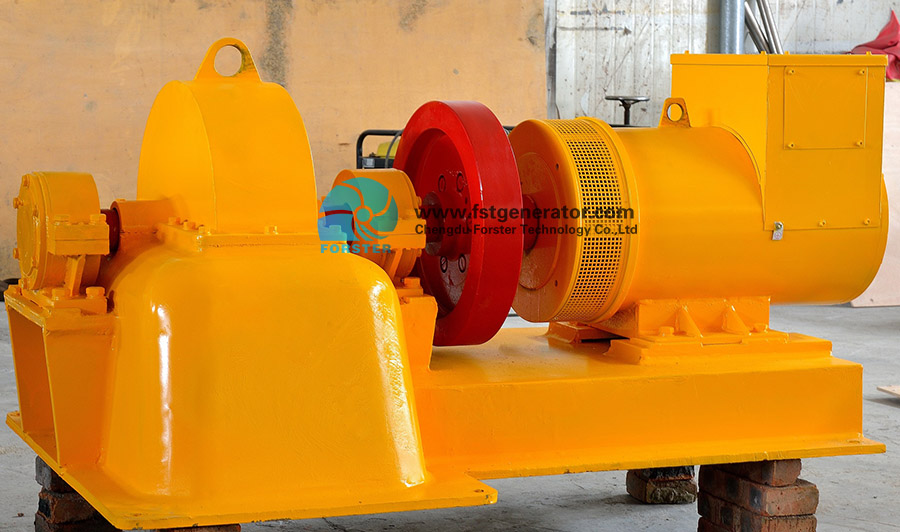
3.5. Cross-Flow Turbine (Banki-Michell)
This is an impulse turbine, but its unique design allows it to be competitive in certain low-head scenarios.
Operating Range: Wide range, but can be effective for heads from 5 to 200 meters. In the low-head context, it suits very small-scale projects.
Key Advantage: Simple, robust construction, low cost, and good efficiency over a range of flows. It can handle debris better than more complex turbines.
Disadvantage: Generally lower peak efficiency than Kaplan or Bulb turbines.
Application: Micro-hydropower and small, remote community projects with limited budgets.
4. Conclusion
There is no universal “best” turbine for all low-head applications. The Kaplan turbine, with its unparalleled flexibility, is often the preferred choice for a broad spectrum of projects. However, for the very lowest heads with high flows, the compact Bulb or Tube turbine designs become indispensable. For small-scale, cost-driven projects, the rugged Cross-Flow turbine remains a viable option. Ultimately, the optimal selection is a finely balanced engineering compromise that harmonizes the immutable physics of the site with economic, operational, and environmental imperatives to ensure a sustainable and profitable power generation asset.
Post time: Sep-22-2025
