Hydropower stands as a cornerstone of global renewable energy, providing clean, reliable, and cost-effective electricity. However, its reliability is intrinsically tied to a single, volatile variable: the flow of water. Understanding the impact of flow variation is crucial for optimizing power generation, ensuring grid stability, and planning for a climate-resilient future.
The Fundamental Equation: Power, Head, and Flow
At its core, the electrical power output of a hydropower plant is governed by a simple formula:
P = η * ρ * g * Q * H
Where:
P = Power Output
η = Overall Efficiency
ρ = Density of Water
g = Gravitational Acceleration
Q = Flow Rate (the volume of water per second)
H = Head (the height the water falls)
From this equation, it is clear that Flow Rate (Q) is a direct, linear driver of power generation. Any change in the volume of water reaching the turbines has an immediate and proportional impact on the electricity produced.
The Dual Challenge of Flow Variation
1. The Problem of Low Flow
When water flow falls below the design capacity of a plant, several critical challenges arise:
Reduced Power Output and Revenue Loss: This is the most direct impact. Lower flow means less water to spin the turbines, leading to a drop in electricity generation and subsequent financial losses for the operator.
Operational Inefficiency: Every turbine is designed for a “best efficiency point” at a specific flow rate. Operating at significantly lower flows pushes the turbine outside this optimal range, reducing its efficiency and potentially increasing wear and tear due to cavitation (the formation and collapse of air bubbles, which can damage turbine blades).
Unit Commitment Challenges: In multi-unit power plants, low flows may force the shutdown of one or more generating units. Deciding which units to run and at what capacity becomes a complex optimization problem.
Environmental and Regulatory Constraints: During droughts, environmental regulations often mandate the release of a “minimum flow” to maintain downstream ecosystem health. This further reduces the water available for power generation, creating a delicate balance between energy production and environmental stewardship.
2. The Problem of High Flow
While it may seem that more water is always better, excessively high flows present their own set of complications:
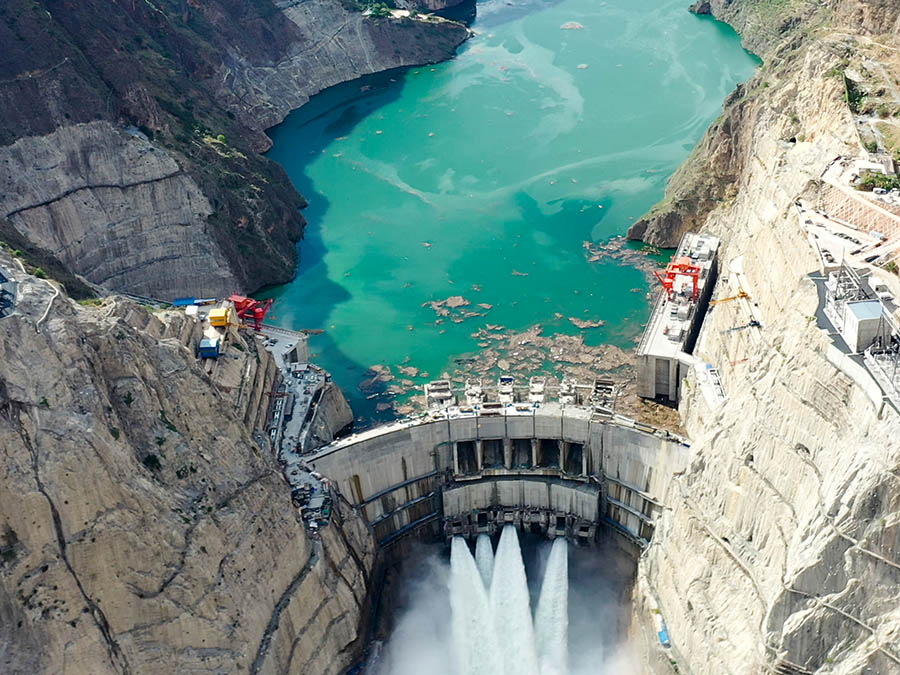
Spillage and Wasted Energy: When inflow to a reservoir exceeds its capacity or the maximum discharge capacity of the turbines, operators must “spill” the excess water over the dam. This represents a direct waste of potential energy that could have been converted into electricity.
Turbine Design Limits: Each turbine has a maximum flow rate it can safely handle. Exceeding this limit can cause mechanical stress, vibration, and damage to the runner and other components.
Sedimentation Issues: High-flow events often carry a large amount of sediment and debris. This can cause abrasion of underwater components and clog intake screens, requiring costly maintenance and cleanup.
Adapting to a Variable Flow Regime
The hydropower industry employs several strategies to mitigate the impacts of flow variation:
Reservoirs and Dams: The primary solution is storage. Reservoirs act like a battery, capturing high flows during wet seasons and releasing stored water for generation during dry periods. This smooths out natural variability and ensures a more reliable power supply.
Advanced Turbine Technology: The development of adjustable-blade turbines, such as Kaplan (for low-head) and Francis (for medium-high head), allows for efficiency to be maintained over a wider range of flows. Turgo turbines (as mentioned in your previous query) are also known for their good efficiency under variable flow conditions.
Predictive Analytics and Forecasting: Using meteorological data and hydrological models, operators can forecast inflows with increasing accuracy. This allows for better reservoir management, deciding when to store water and when to generate maximally in anticipation of future high or low-flow events.
Cascading Systems: A series of hydropower plants on the same river can be operated in coordination. The regulated release from an upstream plant becomes the inflow for the downstream plant, reducing extreme flow variations for the entire system.
The Climate Change Factor
Climate change is amplifying the challenge of flow variation. Many regions are experiencing more intense and frequent hydrological extremes: prolonged droughts and more severe precipitation events. This makes the historical flow data, on which most dams were designed, less reliable. Modern hydropower planning must, therefore, incorporate climate resilience, designing and operating plants for a future with greater hydrological uncertainty.
Conclusion
Flow variation is not a peripheral issue but a central reality of hydropower generation. From the fundamental physics of power generation to the complex operational and environmental decisions, the volume of water flowing through a plant dictates its performance, economics, and sustainability. By leveraging smart technology, sophisticated forecasting, and flexible design, the hydropower sector can continue to navigate these variations, securing its vital role in a clean and stable energy grid.
Post time: Nov-05-2025
